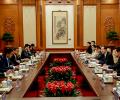
'We remain in touch with the Chinese side, in Beijing as well as in Delhi, to bring predictability in the supply chain.'
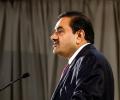
Ports-to-energy conglomerate Adani Group saw a 29 per cent rise in tax outgo across portfolio companies to nearly Rs 75,000 crore, it said on Thursday. This includes both direct and indirect taxes paid, as well as payments towards employee social security.

The states will be able to raise additional open market loans of about Rs 21,000 crore (Rs 210 billion) in the current year, according to the 2009-10 Budget estimates presented on Monday. According to Budget estimates of 2009-10, the states' share of taxes and duties is expected to increase to Rs 1,64,361 crore (Rs 1,643.61 billion) against Rs 1,60,179 crore (Rs 1,601.79 billion) in 2008-09.
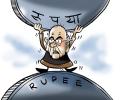
Fiscal deficit has a bearing on sovereign rating of the country as well as the debt market.

The trigger for international gold prices rising to $3,000 per ounce was Germany's upcoming heavy government borrowing.
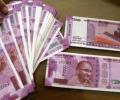
The panel may include or seek inputs from former RBI Governor Urjit Patel, former chief economic advisor Arvind Subramanian, Sajjid Chinoy of the PM-EAC, Rathin Roy, among others.

President Droupadi Murmu's address to the nation on the eve of the 79th Independence Day.

Anant Ambani, the youngest son of billionaire Mukesh Ambani and the first among three siblings to be appointed executive director on flagship Reliance Industries, will be paid Rs 10-20 crore salary annually plus a host of perks including a commission on company profits, according to a shareholder notice. While the richest Asian's all three children - twins Akash and Isha, and Anant - were inducted on board of the oil-to-telecom-and-retail conglomerate in 2023 as non-executive directors, the youngest of the three was in April this year appointed executive director of Reliance Industries Ltd.

This is because the bond market has factored in the Rs 4.88-trillion gross borrowing for April-September 2020.

From the 30-share blue-chip pack, ITC Hotels, IndusInd Bank, Mahindra & Mahindra, Sun Pharma, UltraTech Cement and NTPC were among the biggest gainers. Titan, Kotak Mahindra Bank, Nestle, Asian Paints, HCL Tech and ICICI Bank were among the laggards.

Budget 2025-26 delivers a carefully calibrated strategy-stimulating demand and investment while keeping fiscal discipline intact. In an environment marked by global trade disruptions, and a softening in urban consumption, Finance Minister Nirmala Sitharaman has taken a measured approach.
The Union government gives debt and interest relief under the debt consolidation and relief facility to the states, which meet their targets set by Fiscal Responsibility and Budgetary Management acts. As part of the second stimulus package, states were allowed to deviate from their FRBM targets by 0.5 percentage points to go for a higher fiscal deficit of 3.5 per cent to incur additional capital expenditure to counter the slowdown in the economy of their states.

For the first time, the government is likely to dip into the Oil Industry Development Fund (OIDF) to finance part of its fertiliser subsidy programme for 2025-26, according to official sources. The finance ministry has accounted for Rs 23,000 crore in the FY26 Budget as net additional resources to be drawn from dedicated reserve funds, including the OIDF, the Agriculture Infrastructure and Development Fund, and the Universal Service Obligation Fund.

Fitch Ratings director Thomas Rookmaaker said India's debt-to-GDP ratio is likely to rise to 76 per cent from 70 per cent currently due to wider fiscal deficit and low economic growth.
According to the 2021 England and Wales Census data, of the 915,855 citizens born in India, 49 per cent (444,500) said English was their main language, followed by 41 per cent (373,583) who said another language was their main language but that they spoke English very well or well.

The growth momentum in the Indian manufacturing sector improved in April, with output increasing at the fastest pace since June 2024, on the back of another strong expansion in order books, a monthly survey said on Friday. The seasonally adjusted HSBC India Manufacturing Purchasing Managers' Index (PMI) rose from 58.1 in March to 58.2 in April, indicating the strongest improvement in the health of the sector for ten months.

India's manufacturing sector growth fell to a 14-month low in February amid softer increase in new orders and production, a monthly survey said on Monday. The seasonally adjusted HSBC India Manufacturing Purchasing Managers' Index (PMI) registered 56.3 in February, down from 57.7 in January, but remained firmly within the 'expansionary' territory. In PMI parlance, a print above 50 means expansion, while a score below 50 denotes contraction.
The rise in the fiscal deficit, which is a reflection of the government's borrowing, was mainly on account of subdued tax collection. The revenue deficit also rose to 3.27 per cent, up from the revised estimate of 2.4 per cent of the GDP.
The RBI on Wednesday slashed key interest rate by 25 basis points, for the second time in a row, to support a shuttering economy hit by reciprocal tariffs imposed by the US. Following the rate cut, the key policy rate eased to 6 per cent providing relief to home, auto and corporate loan borrowers.

In a virtual briefing, Royce Murray, assistant secretary for Border and Immigration Policy, US DHS, in response to a query related to the October 22 charter flight that deported a batch of Indian nationals, said, "no minor" among them on that removal flight, adding these were all male and female adults.

All eyes will be on whether Sitharaman will deliver a populist budget leaving more money in hands of the common man or push the reform agenda by staying on the fiscal glide path to lower the fiscal deficit to 4.5 per cent of GDP by 2025-26.

India's second-largest IT company Infosys on Thursday reported an 11.7 per cent decline in consolidated net profit to Rs 7,033 crore for the March quarter. It had posted a profit (attributable to owners of the company) of Rs 7,969 crore in the year-ago period.

Finance ministers of states demanded an increase in allocation under 50-year interest-free loan scheme, while fiscally stressed states like Punjab and Kerala pitched for a special package and borrowing flexibility, sources said on Friday. In a pre-budget meeting with Union Finance Minister Nirmala Sitharaman, states have also urged for higher borrowing limits to support fiscal activities, besides additional funds for Jal Jeevan Mission.

Gross GST collections rose by 9.1 per cent to about Rs 1.84 lakh crore in February, boosted by domestic consumption and indicating potential economic revival. As per the official data released on Saturday, on a gross basis, mop up from Central GST stood at Rs 35,204 crore, State GST at Rs 43,704 crore, Integrated GST at Rs 90,870 crore and compensation cess of Rs 13,868 crore.

India's services sector activity witnessed a sharp uptick in February boosted by improving domestic and international demand, which resulted in a quicker expansion in output and a substantial increase in employment, a monthly survey said on Wednesday. The seasonally adjusted HSBC India Services PMI Business Activity Index rose from January's 26-month low of 56.5 to 59.0 in February, indicating a sharp rate of expansion.

Maruti Suzuki India (MSIL) said on Thursday its operations are unaffected by the global rare earth magnet shortage, but added that the situation is "uncertain and evolving". The firm said it is exploring multiple solutions to maintain continuity in operations and will notify stakeholders in case of material impact.

India's manufacturing sector growth rose to an eight-month high in March, driven by quicker increases in factory orders and production amid buoyant demand conditions, a monthly survey said on Wednesday. The seasonally adjusted HSBC India Manufacturing Purchasing Managers' Index (PMI) was at 58.1 in March, up from 56.3 in February, indicating a substantial improvement in the health of the sector that was above its long-run average. In February, India's manufacturing PMI fell to a 14-month low amid softer increase in new orders and production.

Officials said there had been no official word or indication from the top yet. The expectation from officials is to do what they can, but it is understood that all fiscal and budgetary targets don't matter anymore.

'The first and most basic responsibility of any government is to protect its people from external threats and internal harm.' 'Budget 2025-2026 has to focus on meeting this responsibility,' asserts R Jagannathan.

The recent agreement between the RBI and the Centre marks a significant step forward toward financial inclusion.

Finance Minister Arun Jaitley presented the Budget in Parliament on Saturday.

The government further said the gross tax revenue as a per cent of GDP is expected to increase to 12.1 per cent of GDP in 2019-20 and stabilise at that level in 2020-21 before climbing up to a level of 12.2 per cent of GDP.

Even with the possible expenditure roll-overs and off-budget financing, the fiscal deficit target will not be met. The FRBM Act, after its amendment in 2018, allows a fiscal deficit slippage of not more than 0.5 per cent for any given year, provided there are justifications. These justifications include war, national security, severe collapse in the agriculture sector, a major natural calamity, big structural economic reforms, or the decline in real output growth of a quarter by at least 3 percentage points below its average of the previous four quarters.
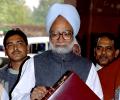
'We are going to need more technical people in government.' 'You can't expect a generalist to understand the complicated world of financial engineering.' 'I regret to say that most of our politicians have no competence to deal with these things. Nor is there a willingness to learn.'

Odisha Chief Minister Naveen Patnaik met Reliance Industries Chairman and Managing Director Mukesh Ambani in Mumbai on Monday, February 27, 2023.

Reserve Bank of India (RBI) Governor Sanjay Malhotra said the repo rate cut in the February meeting of the monetary policy committee (MPC) was due to inflation aligning with the target and recognising the fact that monetary policy is forward-looking.

The government kept its nerve in the face of a massive shock. It chose not to resort to a massive fiscal stimulus. It focused instead on providing liquidity support and easing restrictions on movement in stages, observes T T Ram Mohan.
